
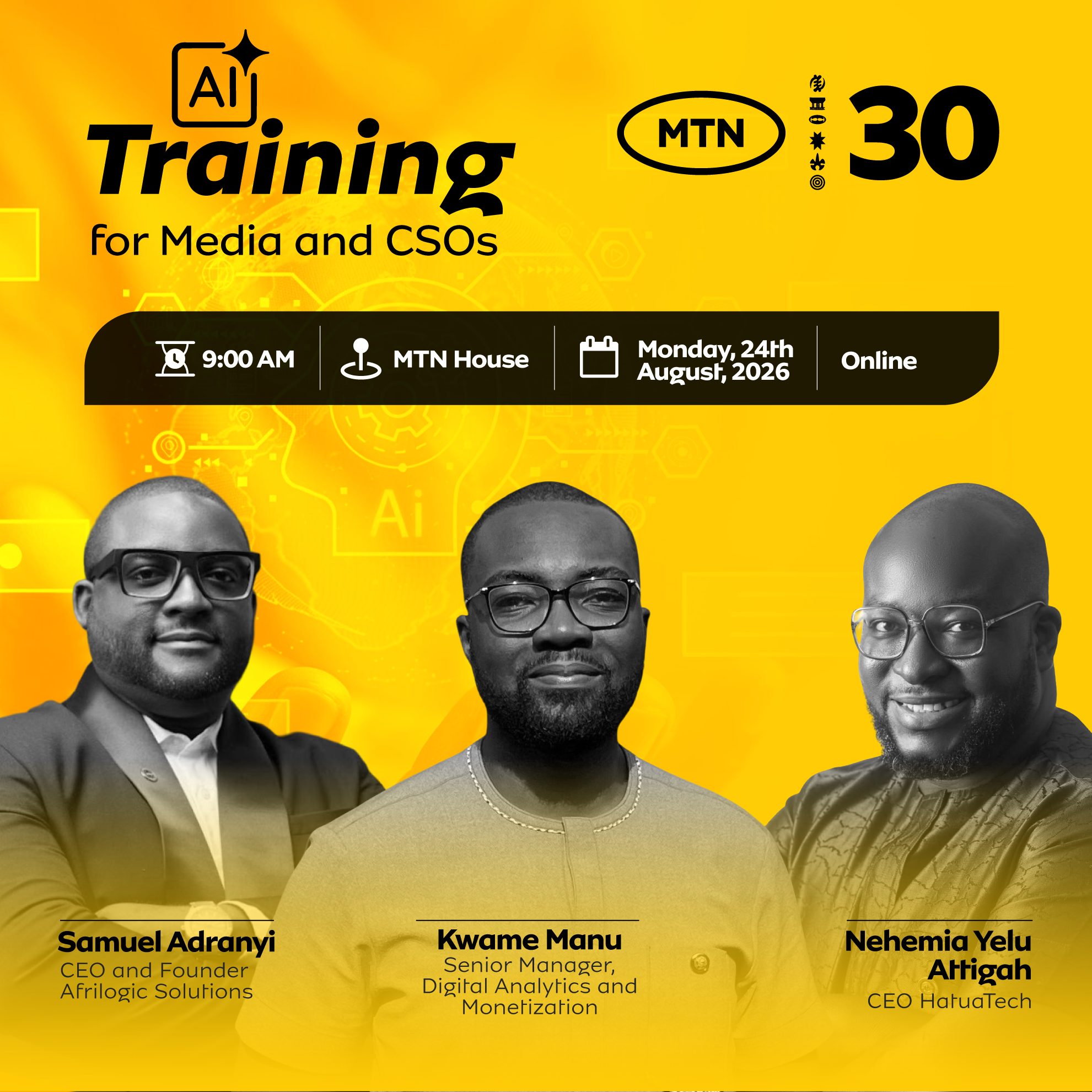
80 journalists, one day, and the AI gap nobody is measuring
Notes from a hands-on session in Accra with a room of journalists and their civil society partners, and what the numbers around the room say about the rest of the continent.
We walked into the room expecting to explain what a large language model is.
Within the first fifteen minutes it was clear that the briefing was unnecessary. When we asked who had used an AI tool in the past seven days, almost every hand in the room went up. Not for a demo. For work. Transcribing an interview on the deadline. Cleaning up a press release. Translating a quote. Drafting a social caption at eleven at night.
The gap in that room was never access. It was something harder to see and considerably more expensive to get wrong.
The gap is not generation. It is verification.
Here is the whole problem in two numbers, from Broadcast Media Africa’s 2026 Africa Readiness Survey of media organisations across Sub-Saharan Africa: 94% of media leaders report being familiar with AI. Only 9% have fully integrated AI-powered fact-checking.
Read those together, and the picture is uncomfortable. The continent’s newsrooms have adopted the half of this technology that produces things, and almost none of the half that checks them. We have industrialised output and left verification where it was.
That asymmetry showed up in the room exactly as the data predicts. Ask people to generate something, and they move fast and well. Ask them how they would establish whether a piece of media in front of them is real, and the room slows down. Not because people are careless. Because nobody has given them a repeatable way to do it that fits inside a deadline.
That is a training problem, and it is a solvable one. But it only stays solved if the method survives contact with the tools changing underneath it.
The tools people trusted have been quietly disappearing.
This is the part that surprises people most, and it is the reason we no longer teach verification as a list of websites.
In January 2025, TrueMedia.org, the nonprofit deepfake detector that a great many journalists had bookmarked, shut down and open-sourced its technology. Its founder was candid about why: the service was built for the 2024 election cycle, and the cost of maintaining it did not survive the charter.
In June 2025, Google stopped showing ClaimReview fact-checking snippets in search results, ending a decade of surfacing fact-checks directly against claims. Google’s stated reason was that the feature was not commonly used and no longer added significant value. Fact-checkers were not shown the data behind that conclusion.
Put those two together, and the trend is not subtle. Generation capability is expanding and getting cheaper. Verification infrastructure is contracting and, in places, being switched off. A newsroom whose verification capability is a folder of bookmarks is carrying an asset with a shelf life it does not control.
So the thing worth teaching is not the tool. It is the sequence of questions that stays true when the tool is gone. Tools are taught as current examples of a method, and the method is what people keep.
Confidence is the risk, not ignorance.
The most useful reframe of the day, and the one that landed hardest, is this.
The person most likely to publish a fabricated quote is not the colleague who has never opened an AI tool. That person is slow and suspicious, and suspicion is protective. The risk sits with the confident intermediate: fluent enough to move quickly, not yet burned enough to check.
Ignorance makes you careful. Fluency makes you fast. Fast is what gets published.
We built the day around that specific failure mode rather than around a tour of tools, and it changes what a session has to do. It is not enough to show people what AI can produce. They have to feel, in the room and with their own work in front of them, the exact moment where a confident output turns out to be wrong. You cannot lecture someone out of overconfidence. You have to let them meet it.
The policy vacuum is bigger than the skills gap
Here is what we did not expect to spend as much time on as we did.
Ask a room of journalists and communications staff which AI account they use for work, and a lot of the answers are personal accounts on free tiers. Source material, embargoed documents, draft copy, sometimes client information, going into services the organisation has no agreement with and no visibility into.
The survey data says this is structural, not local. Across sub-Saharan African media organisations, 53% have no formal guidelines for generative AI use, only 11% have a formal AI strategy, and 56% have no in-house AI expertise at all. Three quarters say the national regulatory position is unclear or absent, so there is not much external pressure forcing the issue either.
No training day fixes that. A policy does, and it does not need to be long. The one-page version that actually gets read beats the forty-page version that gets filed. In our experience it needs to answer three questions and can stop there:
- What may never be pasted into a tool the organisation does not control? Name the categories. Sources, unpublished material, personal data, anything under embargo.
- What must be disclosed to the audience, and where? Decide once, in advance, rather than in the middle of a controversy.
- Who signs off before AI-assisted work is published? A named role, not a general expectation of good judgement.
Write that, circulate it, and you have moved further than most organisations on the continent. Everything after that is refinement.
Your audience already stopped trusting the feed.
One more number, because it changes the commercial argument rather than the ethical one.
A May 2026 report on media and PR in Nigeria found that 84% of audiences already struggle to distinguish real information from fake content online.
Most of a market that cannot tell the difference. The instinctive read is that this is bad news for publishers. It is the opposite. When the audience cannot tell, being fast stops being a differentiator, because everyone is fast and half of it is wrong. What becomes scarce, and therefore valuable, is being the outlet whose work still stands up when someone checks it.
Verification stops being a compliance chore at that point and becomes the product. That is a strategy conversation, not a training one, and it belongs with the people who set editorial direction rather than the people running the tools.
What we would do differently
Three honest things, because a session that produced no corrections would not have been a real one.
The policy conversation deserved more room than we gave it. We scoped the day around capability and found that the organisational questions kept pulling focus, correctly. Next time that gets its own block rather than the space between other things.
The best learning in the room did not come from the front. It came sideways, from people at the same table showing each other what had worked in their own newsrooms. We had designed for that, and we still underestimated how much of the value sat there.
[Add here: one genuine operational lesson. Connectivity, room setup, timing, the mix of media and civil society participants in one room, whatever actually bit. Specific beats diplomatic.]
Where this goes next
The pattern is consistent enough across the sessions we run that we now treat it as the starting assumption rather than a finding: teams do not need to be convinced that AI matters. They need a method for checking its output, a policy that makes the boundaries explicit, and enough practice to have felt the failure mode before it happens in production.
That is what Afrilogic Skill Hub exists to deliver. We run hands-on sessions for newsrooms, agencies, civil society programmes and enterprise teams across Ghana and West Africa, with a certification track for people who want the credential and not just the day.
If you are working out what your team actually needs, we are happy to have that conversation before there is anything to buy. Tell us what your team is already doing with AI and where it worries you, and we will tell you honestly whether a session is the right answer.
